SHIPPING ORDERS FOR CHRISTMAS WILL BE AVAILABLE AFTER THANKSGIVING
TO SHIP FOR THE 2027 MARDI GRAS KING CAKE SEASON, THOSE DATES WILL BE AVAILABLE AFTER DECEMBER 27, 2026
The Smallest Mardi Gras Floats Ever Made
Mardi Gras has never been known for thinking small. New Orleans parades are famous for towering floats, elaborate decorations, marching bands, costumed riders, and crowds that stretch for blocks. During Carnival season, bigger often seems better, which makes one particular parade tradition especially funny: some Mardi Gras floats are small enough to fit inside a shoebox.
Miniature Mardi Gras floats have been part of the Carnival imagination for generations, especially among children who create shoebox floats for school projects. New Orleans eventually took that familiar idea in a wonderfully strange direction by putting tiny floats into an actual street parade. The result is one of the most unusual spectacles of Carnival, proving that a float does not need to tower over a crowd to get everyone's attention.
When Mardi Gras Decided to Go Small
The best-known miniature Mardi Gras parade is organized by ‘tit Rex, a New Orleans micro-krewe that builds its floats on shoebox bases. The krewe was created as a playful response to the enormous floats, huge memberships, and increasingly elaborate productions associated with some of the city's biggest Carnival organizations. Instead of trying to build something larger, ‘tit Rex went in exactly the opposite direction.
The name itself plays with that idea. “’Tit” refers to something petite or small, while Rex means “king,” creating a deliberately funny contrast between tiny floats and the grand traditions associated with Carnival royalty. The concept might sound like a novelty until you see how much work goes into the floats, because these little creations can contain an impressive amount of detail.
How Small Are the Smallest Mardi Gras Floats?
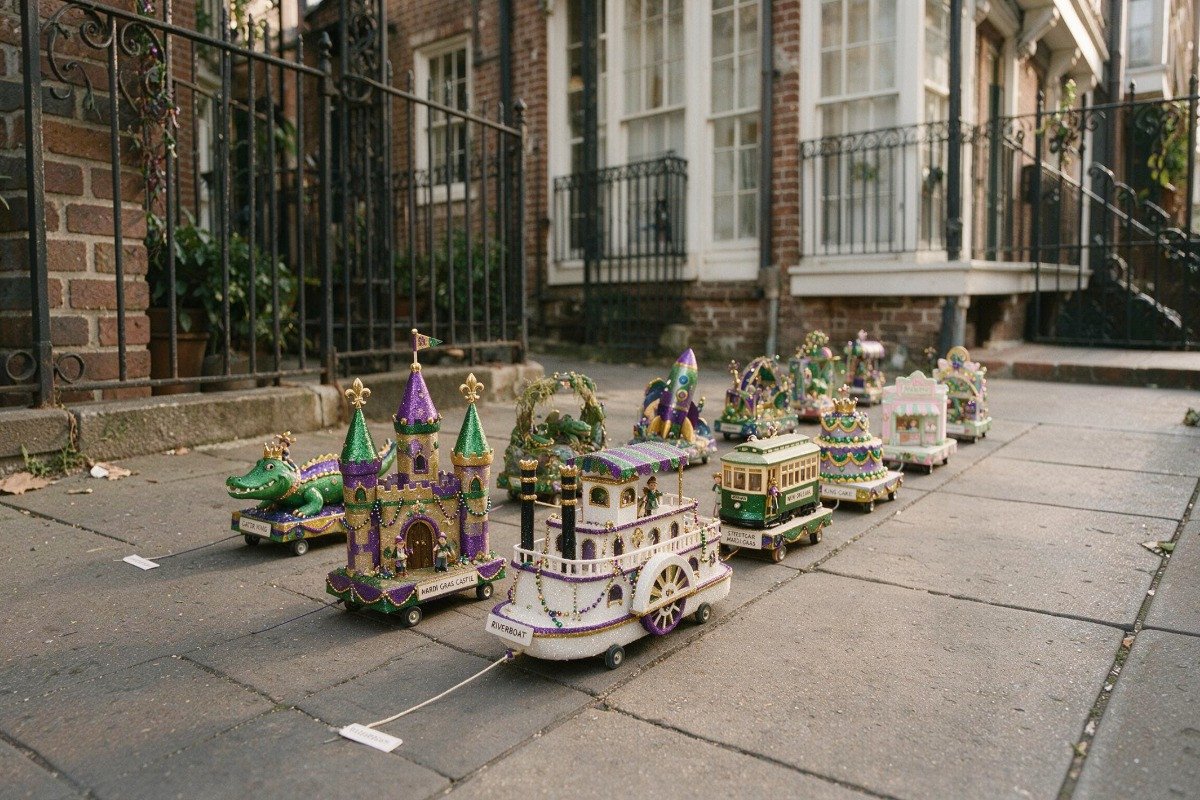
Picture a conventional Mardi Gras float, then shrink the entire thing until one person can pull it along the street. That is roughly the world of ‘tit Rex. Every float begins with a shoebox as its foundation, although artists can build upward and outward as they transform that simple base into something much more elaborate. The krewe's own description has even referred to members pulling 13-inch shoebox floats through New Orleans streets.
Rather than placing riders several feet above spectators, these floats travel close to the pavement. People standing along the route can crouch down for a better look at the details, which changes the normal relationship between a Mardi Gras float and its audience. A traditional float commands attention through scale, while a miniature float makes you lean closer because you want to see what the artist managed to squeeze into such a small space.
Where Did the Shoebox Float Tradition Come From?
Long before miniature floats became an organized street attraction, children were making their own versions in classrooms and at home. Decorating a shoebox to resemble a Mardi Gras float became a familiar school activity, particularly in places where Carnival traditions are part of everyday culture. Children could take cardboard, construction paper, beads, paint, foil, glitter, toys, and almost anything else they could find and turn an ordinary box into their own parade entry.
That childhood tradition directly inspired ‘tit Rex. The krewe says its floats take their cue from the generations-old practice of decorating shoeboxes as Mardi Gras floats, turning a familiar school project into an adult Carnival art form. What once traveled across classroom desks now rolls through New Orleans streets as part of an organized procession.
Why Would Adults Parade With Shoebox Floats?
Because this is Mardi Gras, of course.
Carnival has always provided room for humor, satire, costumes, exaggeration, and the occasional deliberate rejection of what everyone else is doing. When enormous floats become normal, building an extraordinarily tiny one suddenly becomes a statement of its own. The small size also places more attention on individual craftsmanship, since spectators are examining a miniature scene rather than taking in a giant structure from across the street.
‘Tit Rex maintains the feeling of a true micro-krewe by keeping its parade relatively compact. The organization says its procession is capped at around 30 floats, with each float having a float master and as many as two additional participants. That limitation helps preserve the miniature character of the event instead of allowing it to grow into the very kind of massive parade it was created to contrast with.
Tiny Floats Can Have Surprisingly Big Personalities
A small float does not necessarily mean a simple float. Miniature builders face many of the same creative decisions as artists working on conventional parade floats, except everything must be accomplished within a fraction of the available space. Lighting, moving pieces, decorations, structural elements, figures, signs, and visual jokes all have to work at miniature scale.
That constraint can actually make the designs more interesting. Artists cannot simply fill an enormous surface with decorations, so every feature becomes more noticeable. A tiny figure placed in the wrong spot can change the entire composition, while an inventive use of a household object can suddenly become a building, vehicle, character, or piece of scenery.
Even the Mardi Gras Throws Get Smaller
A Mardi Gras parade without throws would feel incomplete, so naturally a parade of miniature floats needed miniature throws. ‘Tit Rex has become known not only for its shoebox-sized creations but also for tiny versions of the objects spectators expect to receive during Carnival. New Orleans tourism organizations specifically highlight the krewe's miniature floats and its small throws as part of what makes the parade unusual.
The idea fits perfectly with the joke. Spectators accustomed to reaching for beads and other colorful parade treasures suddenly find themselves looking for much smaller keepsakes. That attention to scale helps make the procession feel like a completely developed miniature version of Mardi Gras rather than simply a group of people pulling decorated boxes.
Small Floats Bring People Closer to the Art
One of the interesting things about miniature floats is that they encourage spectators to slow down. A massive float can be appreciated immediately because its shapes, colors, and characters are designed to be visible from a distance. A shoebox float invites inspection, since the best details might be only a few inches tall.
That closeness creates a different parade experience. People notice tiny signs, carefully constructed characters, miniature scenery, and jokes that would disappear on a conventional float. The street temporarily feels a little like an outdoor art gallery, except the exhibits are rolling past the audience one tiny float at a time.
Are These Really the Smallest Mardi Gras Floats Ever?
Individual children have undoubtedly created shoebox floats, model floats, and Carnival decorations that are smaller than the entries in an actual street parade, which makes declaring one object the literal smallest Mardi Gras float difficult. The more interesting distinction is that ‘tit Rex takes miniature floats out of the classroom and puts them into a genuine New Orleans Carnival procession.
Mardi Gras New Orleans has described ‘tit Rex as a micro-krewe whose members parade with miniature shoebox floats, while New Orleans tourism resources regularly include the procession among the city's distinctive smaller Carnival celebrations. In practical terms, these are some of the tiniest floats you are likely to see participating in a real Mardi Gras street parade rather than sitting on a desk or shelf.
Shoebox Floats Are Still Fun to Make at Home
You do not need to belong to a krewe to create a miniature Mardi Gras float. A shoebox provides an easy starting point, while cardboard, tissue paper, foil, beads, ribbon, paint, craft foam, small toys, and recycled materials can supply the decorations. Families can choose a theme, build several floats, and create an entire tabletop parade.
The activity is especially enjoyable because there is no single correct way to build one. A shoebox can become a riverboat, castle, alligator, streetcar, bakery, space station, swamp scene, or practically anything else the builder imagines. Adding miniature riders and tiny throws can make the finished float feel even more like something that belongs on a New Orleans parade route.
Mardi Gras Has Room for Every Size of Celebration
The smallest Mardi Gras floats demonstrate something important about Carnival culture: spectacle is not measured only in feet, riders, or pounds of decorations. A shoebox can attract nearly as much curiosity as a towering float when someone fills it with enough creativity, humor, and personality.
That may be why miniature Mardi Gras floats are so memorable. They take something everyone recognizes and completely change its scale without losing the traditions that make it fun. There are still themes, decorations, crowds, throws, satire, and plenty of Carnival spirit. Everything simply happens much closer to the ground.
From Tiny Floats to King Cakes, Mardi Gras Is Built on Tradition
Mardi Gras would not be Mardi Gras without the traditions people look forward to year after year. Some involve enormous parades filling New Orleans streets, while others can happen around a kitchen table with a shoebox, a handful of craft supplies, and a little imagination. King cake belongs to that same season of shared celebrations, bringing families and friends together before Carnival finally reaches Mardi Gras Day.
Whether you are watching miniature floats roll through New Orleans, helping the kids create their own shoebox parade, or gathering everyone together for a Carnival celebration, make room for another Louisiana favorite. Randazzo King Cakes helps bring the flavor of Mardi Gras to the table, proving that some of the season's best traditions are the ones people can enjoy together, no matter how big or small the celebration happens to be.